
I like RF stuff. That’s the whole origin story. I fell down a rabbit hole this week called OpenMANET, and I’m pretty sure I’m going to build a couple of nodes and then put my own spin on it. This post is me getting the basics straight before I spend any money, so Future Me has something to look back at when the build gets weird.
What OpenMANET actually is
OpenMANET is an open-source mesh radio built from a Raspberry Pi and a Wi-Fi HaLow card. It is not a narrowband digital voice system like DMR. It’s a real IP network that happens to run over radio and builds itself.
- The radio: Wi-Fi HaLow (802.11ah) in the 902–928 MHz band, using Morse Micro chips: the MM6108 (Seeed’s Wio-WM6108 card) or the newer MM8108 (Gateworks cards).
- The computer: a Raspberry Pi 4 or a Compute Module 4 running OpenWrt, plus a daemon called
openmanetdthat handles the web UI, GPS, range testing and push-to-talk. - The mesh: 802.11s mesh links with batman-adv routing on top, so traffic hops node to node and finds a new path if one drops out.
- The network: one flat
10.41.0.0/16LAN. Every node runs its own DHCP server, so phones and laptops still get an address even if their node gets cut off from the rest. Names likemanet01.localwork across hops. - The way out: one node can be the “mesh gate,” which NATs the whole mesh onto Starlink, cellular or whatever uplink you have.
Your phone or laptop connects to a node over Ethernet or the node’s own 2.4/5 GHz access point, and from there it’s just… a network. Anything that speaks IP works.
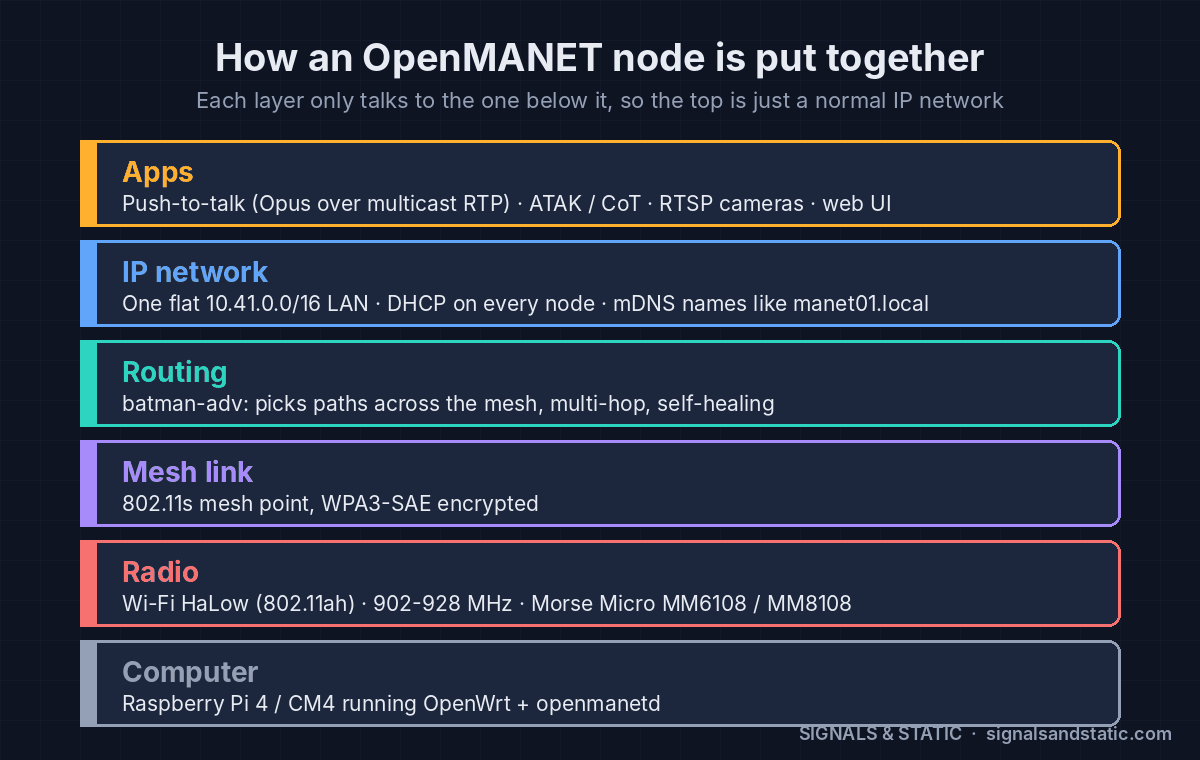
How an OpenMANET node stacks up, from the Pi and HaLow radio to the apps on top.
OpenMANET vs. Meshtastic
If you’ve played with Meshtastic or MeshCore, the easy way to think about OpenMANET is “same idea, a lot more pipe.” LoRa moves text messages and positions. HaLow moves real data: roughly 1 to 15 Mbps depending on the radio, channel width and your country’s rules. That’s enough for:
- Push-to-talk voice (Opus audio over multicast, organized into talk groups)
- ATAK integration, so everyone’s position and markers show up on the map
- RTSP camera streams placed right on that map
- ADS-B to Cursor-on-Target, and a way to join two separate meshes over the internet
The cost is power and money. A Pi plus a HaLow card pulls watts, not milliwatts, and a node runs a lot more than a $25 LoRa board. For what I want to do, that’s a fair trade.
The ham’s question: what is 27 dBm in watts?
The OpenMANET docs mention a tuned radio configuration file that pushes the Seeed card from about 21 dBm to about 27 dBm. I live in the HF/VHF/UHF world, where we talk in watts, so I had to translate.
dBm is decibels referenced to 1 milliwatt. Two rules get you everywhere: +3 dB doubles the power, and +10 dB is ten times the power.
| dBm | Power | For reference |
|---|---|---|
| 20 | 100 mW | |
| 27 | 0.5 W | OpenMANET’s tuned HaLow card |
| 30 | 1 W | Part 15 conducted limit, 902–928 MHz |
| 36 | 4 W EIRP | Part 15 ceiling including antenna gain |
| 37 | 5 W | A typical handheld |
| 47 | 50 W | A typical mobile rig |
| 50 | 100 W | A typical HF rig |

27 dBm is about half a watt. +3 dB doubles power, +10 dB is ten times.
So the whole thing runs on about half a watt. That sounds puny next to a 50 W mobile, but HaLow gets its range from narrow channels and how 900 MHz propagates, not from raw power. Same as on VHF/UHF: antenna height and a decent antenna will buy more than squeezing out a few more dB.
No license needed (and why I’m keeping it that way)
902–928 MHz is an unlicensed Part 15 band. For digitally modulated systems like HaLow, the limit is 1 W conducted with up to 6 dBi of antenna gain, which works out to a 4 W EIRP ceiling. Use a bigger antenna and you have to turn the power down to stay under it. Half a watt into a 2 dBi whip is about 0.8 W EIRP, well inside the line.
The catch is certification. The HaLow modules are certified with specific power settings and antennas, so a config file that raises power can push you outside the grant even while you’re under the absolute limit. And no, having a ham ticket doesn’t change that. I do have one, but I specifically want this project to work for people who don’t, so testing stays inside certified power and antenna combinations.
Why I’m building one
A stock OpenMANET node is already cool. But I keep thinking about where I’d take it:
- A second, faster band (5 GHz) that kicks in when nodes are close together
- A 5G mesh gate using the Quectel RM520N-GL modem already sitting on my bench
- A custom CM4 carrier board instead of a stack of HATs and dongles
- A 3D-printed, admittedly tacticool handheld to put it all in
- A port for the drone detection project I’m working on, so its bearings land on everyone’s ATAK map
The one rule I’m setting for myself from day one: whatever I build has to be able to join anyone else’s stock OpenMANET mesh. Extras sit on top; I don’t fork the core. More on that plan in the next post.
The OpenMANET build log
- Part 1: What OpenMANET is (and why I’m building one) (you are here)
- Part 2: The dual-band, CM4 and handheld plan
- Part 3: Phase 1 parts list
- Part 4: Two-node mesh up, push-to-talk working
- Part 5: The handheld, rendered
- Part 6: A printable Pi 4 test stand
- Part 7: 5 GHz on the mesh
Links if you want to go down the same hole
- OpenMANET documentation
- OpenMANET Raspberry Pi hardware page
- How OpenMANET comms (push-to-talk) works
- OpenMANET firmware releases on GitHub
- CNX Software: OpenMANET, a higher-bandwidth Meshtastic alternative
—
TL;DR: OpenMANET is a Raspberry Pi mesh radio over 915 MHz Wi-Fi HaLow that carries real IP traffic (voice, video, ATAK) on about half a watt, no license required. I’m building two nodes and then making it my own.
Pingback: OpenMANET Dual-Band Plan: HaLow + 5 GHz, CM4 and a Handheld | Signals & StaticSignals & Static
Pingback: Two-Node OpenMANET Mesh Is Up (and Push-to-Talk Works) | Signals & StaticSignals & Static
Pingback: Free STL: Raspberry Pi 4 Test Stand for OpenMANET Nodes | Signals & StaticSignals & Static
Pingback: Teaser: An ATAK Button Case for the Galaxy S9 | Signals & StaticSignals & Static