
In part 1 I got the basics of OpenMANET straight. This one is the plan, and the headline is the OpenMANET dual-band idea: a mesh that runs fast 5 GHz links when nodes are close together and falls back to long-reach 915 MHz HaLow when they drift apart, without the network ever dropping. Plus a handful of other things I want bolted on. Writing it down now so I can see later how far off I was.
Ground rule: stay compatible with stock nodes
I want my radios to join anyone else’s OpenMANET mesh, and theirs to join mine. So everything custom is an add-on on top of the stock firmware, never a fork of the core. For a node to join a mesh, these have to match:
- HaLow mesh ID, encryption key, channel and channel width
- Country/regulatory settings (the radio’s BCF file), so channels and power line up
- A compatible batman-adv version
- The stock network model:
10.41.0.0/16, a DHCP scope per node, one mesh gate
Anything I add has to be invisible or harmless to a node that doesn’t know about it. Before I call any custom feature done, it gets tested against an untouched stock node.
How OpenMANET dual-band works: let batman-adv do it
This turned out to be the easy part, because the mesh stack already supports it. batman-adv can bond several radio interfaces into one mesh. Add a 5 GHz 802.11s interface next to the HaLow one, attach both to the same bat0, and BATMAN_V picks routes by measured throughput.
- Close together: the 5 GHz hop is way faster, so traffic moves onto it automatically. Clearer voice, video and file pushes.
- Far apart: 5 GHz falls out of range and traffic falls back to HaLow. The network slows down; it doesn’t drop.
- Stock nodes without a 5 GHz radio just see a normal HaLow mesh.
RTSP video, ATAK and file transfers get the benefit without knowing anything about it. They ride whichever link batman-adv picks.
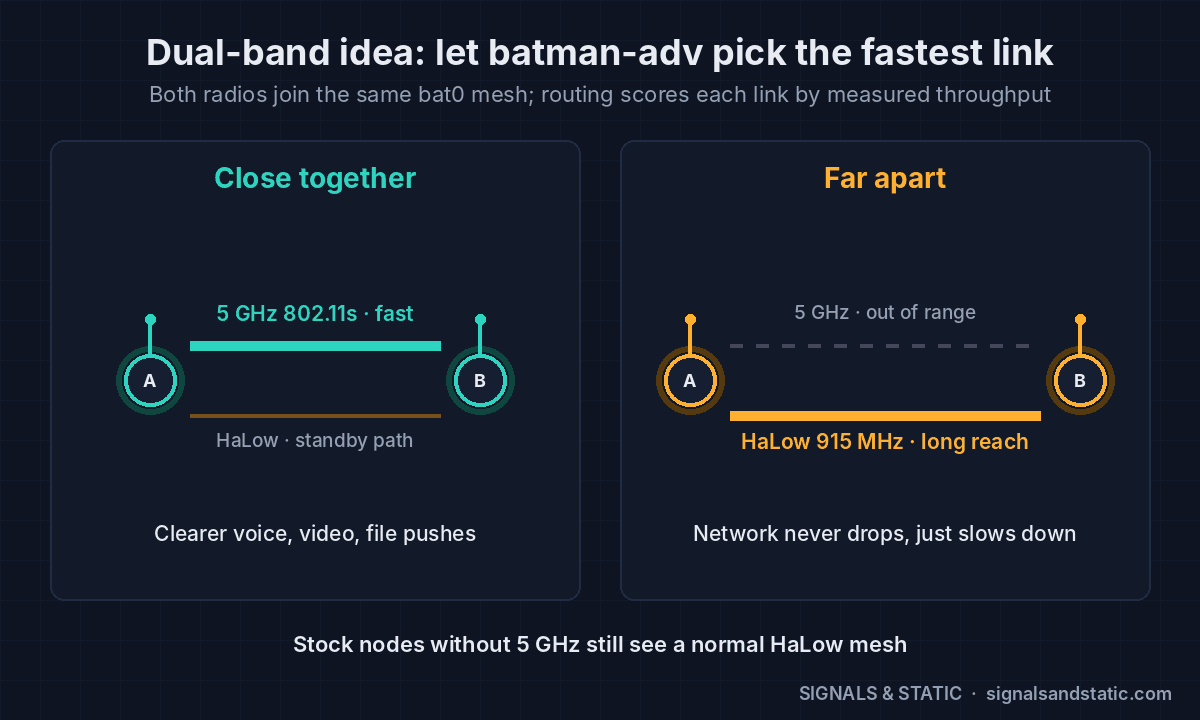
Close in, batman-adv moves traffic onto 5 GHz. Far apart, it falls back to HaLow.
Not every 5 GHz radio can mesh
The radio has to support 802.11s mesh point mode, and a lot of popular cards don’t. Per the OpenMANET docs: the MT7916AED and MT7915DAN work (stability varies with kernel and driver), the QCA6174 works but only one network at a time, and the Intel AX200/AX210 and MT7921 are access-point only.
The Pi 4 only has USB for a second radio, so testing will use a MediaTek mt76-family USB adapter (MT7612U or MT7610U chips). Rule of thumb: shop by chip, not brand. Avoid MT7921-based Wi-Fi 6 sticks and Realtek RTL88xx adapters for mesh work. The final hardware gets a PCIe M.2 card (MT7916) on the CM4 board.
Voice that gets better when you’re close
Here’s the part I haven’t seen anyone else do. OpenMANET’s push-to-talk already uses Opus audio and adapts its error correction when packets drop. My add-on would go the other way: when every listener in a talk group is on a fast link, bump the Opus bitrate up for clearer audio, and drop back the moment anyone isn’t. Opus decoders follow bitrate changes on their own, so stock nodes still hear it fine.
Is anyone else doing this?
Multi-band mesh isn’t a new idea, to be fair:
- OpenMANET upstream says work is underway to bond HaLow with 2.4 GHz using BATMAN_V. Same mechanism, different band, so I should talk to them before I start rather than duplicate their work.
- Doodle Labs sells 900 MHz + 2.4 GHz Mesh Rider radios, but the whole mesh switches bands together to dodge interference. One band at a time, not a different band per link.
- Silvus has a dual-band StreamCaster with a dual-frequency link feature. Proprietary, and military money.
What’s less common in mine is HaLow plus 5 GHz picked per link, voice that improves when nodes are close, and staying fully open and compatible with stock nodes. The adaptive voice piece is a good candidate to contribute back.
The other add-ons
- 5G mesh gate. One node NATs the whole mesh onto the internet through the Quectel RM520N-GL 5G modem I pulled out of a swap-meet box. Its GNSS can supply that node’s position. On a Pi 4 it needs a USB 3 sled, since the PCIe HAT I was eyeing is Pi 5-only and OpenMANET targets the Pi 4 and CM4.
- Drone DF link. My drone detection stations would plug into a node’s Ethernet port and publish bearings as Cursor-on-Target, so they show up on every ATAK screen on the mesh. Two stations could share bearings for triangulation over the same mesh. It’s all just IP, so the radio core doesn’t change.
The hardware end state: a CM4 handheld
I’ll admit it: I want it to look like a real tactical radio. The inspiration is something like the Silvus SC4200EP handheld, with a vehicle unit later once the hardware and software settle. I know it’s tacticool. I think they look cool. Moving on.
The CM4 is the same silicon as the Pi 4, so OpenMANET support and power draw carry over, but it exposes a PCIe lane the Pi 4 board doesn’t. A custom carrier board in KiCad could put all of this on one board:
- CM4 with onboard eMMC (no SD card to shake loose in the field)
- The HaLow card and a PCIe 5 GHz card on M.2 slots
- GPS, power management and SMA connectors laid out the way I want
- A removable battery pack that clips onto the bottom, so I can swap and keep going, plus a small onboard backup cell to stay alive during the swap
- A PRC-148/152-style battery interface. Plan is to buy one adapter kit to learn the geometry, then 3D-print the radio and battery sides and only buy the metal contacts after that.
No 5G modem in the handheld. Too many antennas, too much heat and power for something you carry. That lives in the mesh gate and maybe the vehicle unit.
The roadmap
- Two stock Pi 4 nodes. Learn the system, bench test, range test.
- Add 5 GHz. Prove dual-band switching on USB adapters.
- 5G mesh gate with the RM520N-GL.
- CM4 carrier board in KiCad.
- Handheld enclosure in FreeCAD, then the battery packs.
- Drone DF link once that project is far enough along.

Six phases, one rule: every node has to join anyone’s stock OpenMANET mesh.
Everything in this stack is unlicensed: HaLow and 5 GHz Wi-Fi are Part 15, and the 5G modem rides a carrier’s license. Next up: the phase 1 parts list.
The OpenMANET build log
- Part 1: What OpenMANET is (and why I’m building one)
- Part 2: The dual-band, CM4 and handheld plan (you are here)
- Part 3: Phase 1 parts list
- Part 4: Two-node mesh up, push-to-talk working
- Part 5: The handheld, rendered
- Part 6: A printable Pi 4 test stand
- Part 7: 5 GHz on the mesh
References
- OpenMANET Raspberry Pi hardware (radio and 5 GHz card notes)
- How OpenMANET comms works (Opus, talk groups, FEC)
—
TL;DR: Bond a 5 GHz radio and the HaLow radio into one batman-adv mesh and routing picks the fast link automatically. Add adaptive voice, a 5G gate and a DF port, then shrink it all onto a CM4 board in a handheld, while staying compatible with stock OpenMANET.
Pingback: OpenMANET Parts List: Two Raspberry Pi 4 HaLow Nodes | Signals & StaticSignals & Static
Pingback: OpenMANET: A Wi-Fi HaLow Mesh Radio Worth Building | Signals & StaticSignals & Static
Pingback: Two-Node OpenMANET Mesh Is Up (and Push-to-Talk Works) | Signals & StaticSignals & Static
Pingback: The OpenMANET Handheld, Rendered: A CM4 Concept in FreeCAD | Signals & StaticSignals & Static
Pingback: OpenMANET 5 GHz: Dual-Band Mesh Results, Breakage and What's Left | Signals & StaticSignals & Static
Pingback: Free STL: Raspberry Pi 4 Test Stand for OpenMANET Nodes | Signals & StaticSignals & Static