
The two Alfa adapters showed up today, so the dual-band plan stopped being a plan. I spent the day adding OpenMANET 5 GHz links to both bench nodes, changing the routing stack to suit, and running every speed, failover and power test I could think of. Some of it worked better than I hoped. One part locked a node up hard. Here’s all of it, plus what’s still left to test.
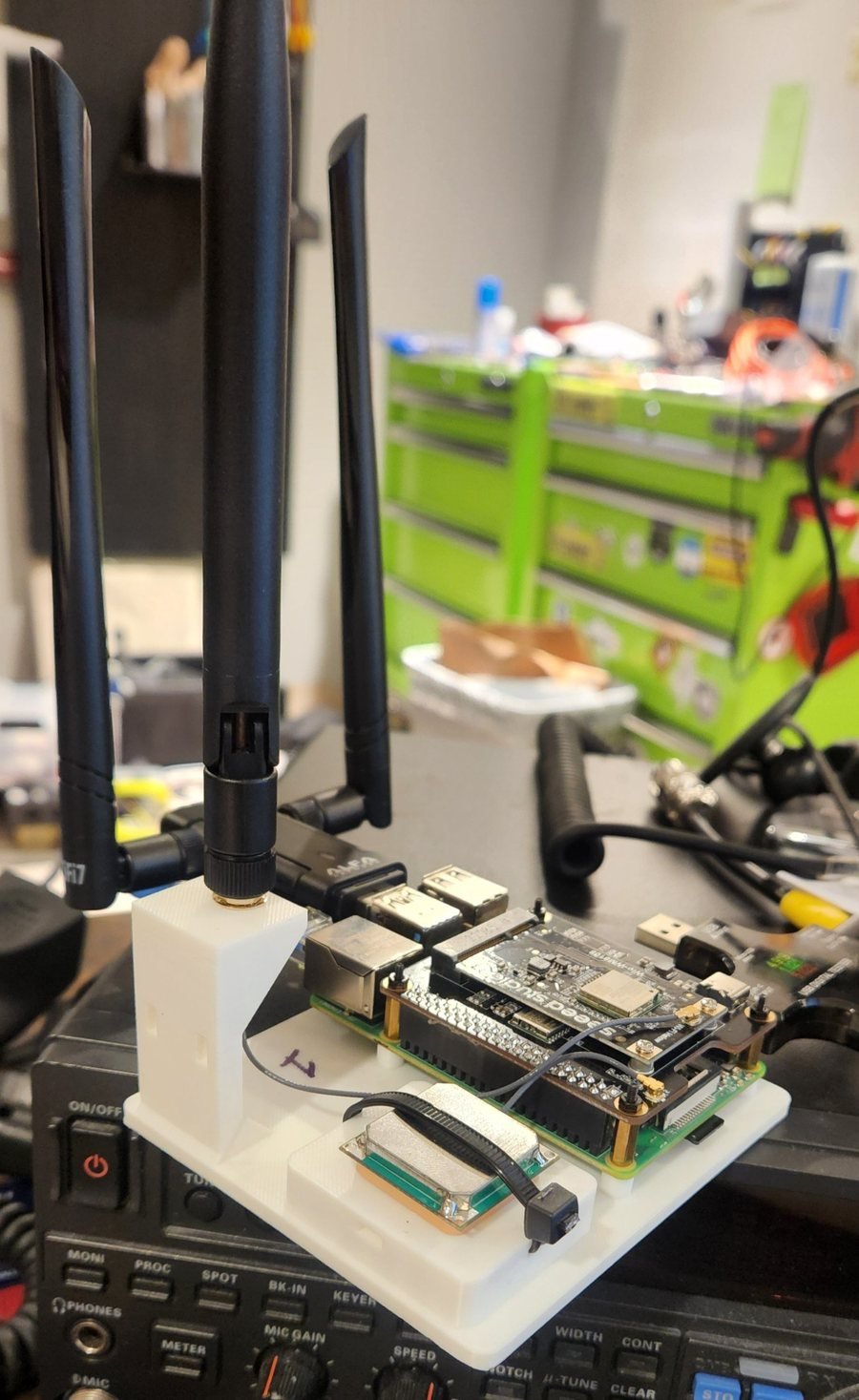
Node 1 on its test stand, with the Alfa 5 GHz adapter riding in a blue USB 3 port.
The hardware: a stand-in 5 GHz radio
The handheld will use an MT7916 card on PCIe. The Pi 4 only has USB, so for bench testing I’m using an Alfa AWUS036ACM (MediaTek MT7612U) on each node. That chip uses the mainline mt76 driver and supports 802.11s mesh point mode, which is the whole point. The Pi’s onboard Wi-Fi stays as the client access point on channel 36.
What I changed in the OpenMANET routing stack
Everything sits on top of stock OpenMANET 1.8.0. Nothing in the core is forked, so a stock node still joins the HaLow mesh like normal.
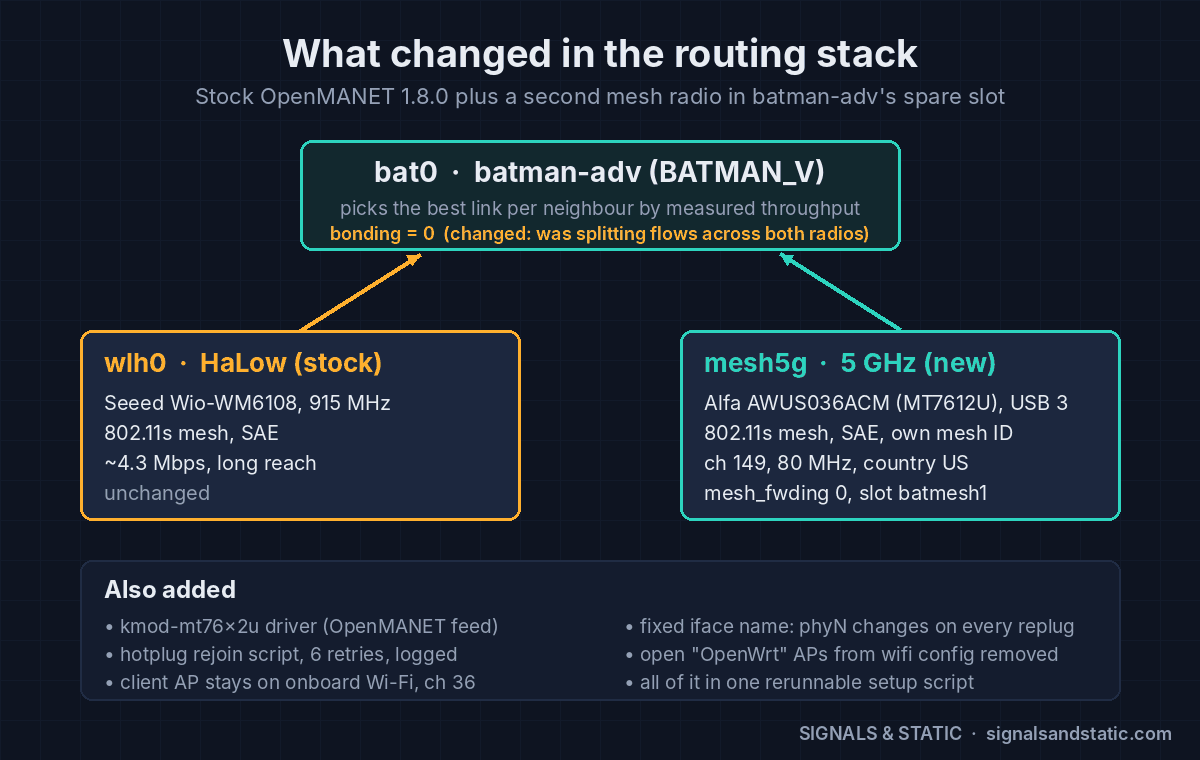
One batman-adv mesh, two radios: stock HaLow plus the new mesh5g interface.
| Change | Why |
|---|---|
Installed kmod-mt76x2u from OpenMANET’s package feed |
The Alfa’s driver isn’t in the 1.8.0 image. |
| Radio set to country US, channel 149, 80 MHz | Without a country code, every 5 GHz channel is listen-only. Channel 149 (UNII-3, no DFS) stays well clear of the client AP on 36. |
New 802.11s interface, mesh5g: SAE-encrypted, its own mesh ID, mesh_fwding 0 |
batman-adv does the multi-hop forwarding, so the Wi-Fi layer shouldn’t. |
Attached to batmesh1, OpenMANET’s spare bat0 slot |
Both radios become interfaces of the same mesh. BATMAN_V scores each link by measured throughput and picks per neighbor. |
| Fixed interface name | The phy number changes every time a USB radio is replugged, which broke everything keyed to it. |
bonding = 0 on bat0 |
With bonding on, batman split transfers across both radios and lost about 35% of the speed (see below). |
Removed the open “OpenWrt” access points that wifi config creates |
They’d broadcast an unsecured network. |
| Hotplug rejoin script, kept across firmware upgrades | The Alfa doesn’t rejoin the encrypted mesh on its own after a replug. The script retries up to six times and logs each attempt. |
All of that now lives in one setup script that’s safe to rerun (it has to be after a firmware upgrade, which drops the driver package) and a matching removal script that puts a node back to HaLow only.
Speed: OpenMANET 5 GHz vs HaLow
Nodes about a room apart, 5 GHz signal around −49 to −51 dBm, PHY rates 526–702 Mbps:
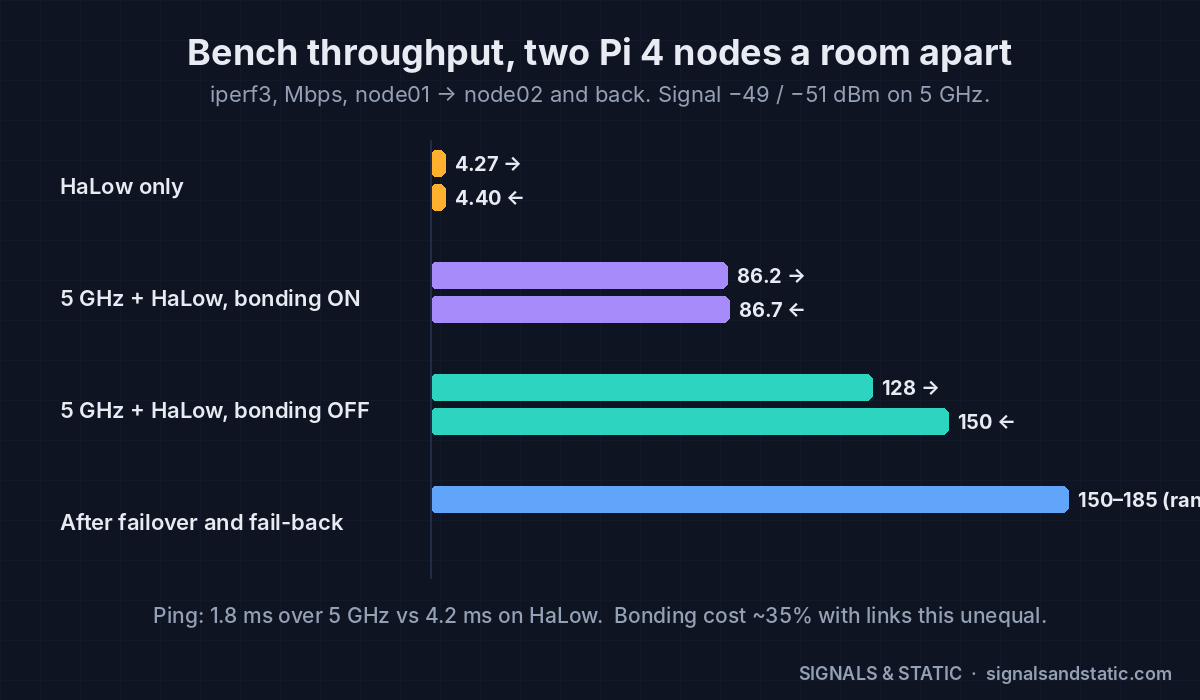
Bench throughput between the two nodes. Turning bonding off was worth about 35%.
| Setup | node01 → node02 | node02 → node01 |
|---|---|---|
| HaLow only | 4.27 Mbps | 4.40 Mbps |
| 5 GHz + HaLow, bonding on | 86.2 Mbps | 86.7 Mbps |
| 5 GHz + HaLow, bonding off | 128 Mbps | 150 Mbps |
| Ping | 1.8 ms over 5 GHz vs 4.2 ms on HaLow | |
Roughly 30–35 times faster up close, which is exactly the “fast when close, long when far” idea. Radio retries were about 3%.
Why bonding hurt: bonding round-robins packets across every link to a neighbor. When one link is 30× slower than the other, the slow one drags the whole transfer down. With bonding off, batman just uses the best link, and the HaLow link sits there as the fallback.
Failover and fail-back
With a ping running once a second, I killed the 5 GHz radio and watched what batman did.
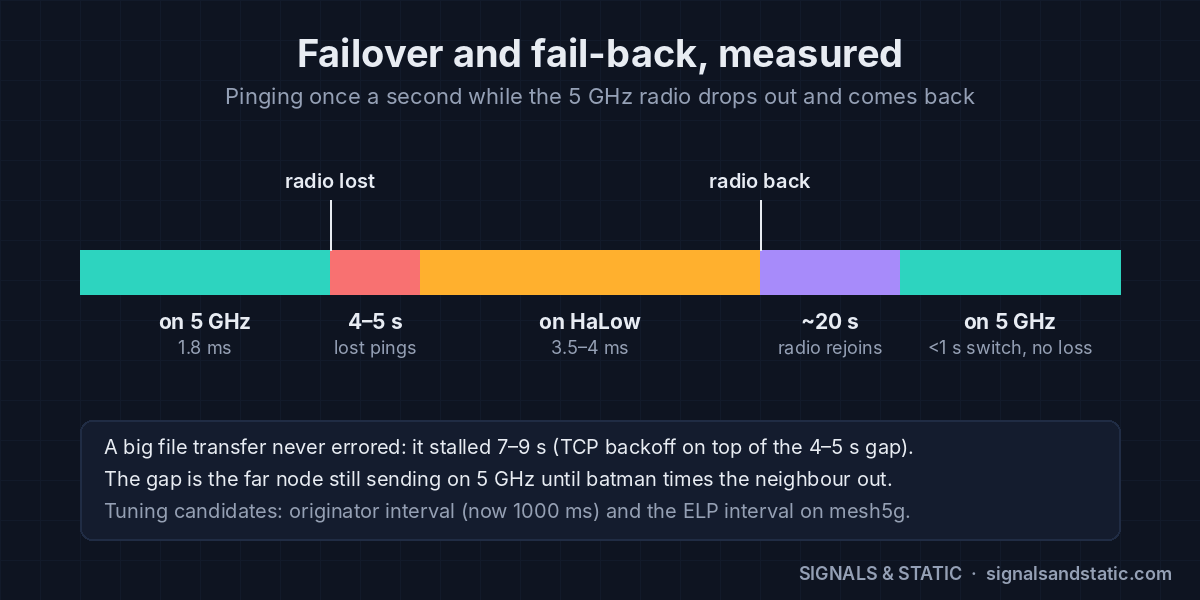
Failover to HaLow costs 4–5 s; failing back costs nothing once the radio has rejoined.
- Failover to HaLow: 4–5 seconds of lost pings, then steady on HaLow at 3.5–4 ms. The gap is the far node still sending over 5 GHz until batman times out that neighbor.
- Transfers survive: a running iperf transfer never errored. It stalled 7–9 seconds (TCP backing off on top of the routing gap) and then kept going on HaLow.
- Fail-back: once the 5 GHz neighbor reappears, batman moves the live transfer back within a second, with no loss. The slow part is the radio rejoining the encrypted mesh, about 20–23 seconds after it comes back.
The hardships
1. Too close is too loud
With the two Alfas side by side, the signal was −23 dBm and the receivers overloaded. One direction collapsed to 12.7 Mbps with heavy retransmits. Moving the nodes a room apart fixed it. The sweet spot on the bench is −40 to −60 dBm.
2. ip link down/up doesn’t rejoin the mesh
Bouncing the mesh interface the Linux way leaves it down as far as the encrypted mesh is concerned. Use wifi, or batctl if del/add to pull it out of batman instead.
3. The adapter wouldn’t rejoin after a replug
The first hotplug script brought the Alfa back two times out of three. The second version retries up to six times, checks that the interface is really up before it quits, and logs every attempt.
4. A kernel lockup from pulling the USB radio
This was the big one. On roughly the fourth hot-unplug, node 1 locked up. The Alfa’s driver timed out with traffic still queued, then the node’s attempt to remove mesh5g from bat0 hung inside the kernel and couldn’t be killed. Every batman query after that piled up behind it: load average hit 2,188, the web UI sat on “Loading…”, and the rejoin script never got to run. SSH still worked, which is how I caught the evidence before a forced reboot.
It looks like a race between a USB radio vanishing and batman removing it (batman-adv 2025.4, mt76x2u, OpenMANET 1.8.0). It happened about one unplug in four.
Does it matter? Not for the handheld: the MT7916 is a PCIe card, and you can’t yank it out of a running radio. In the field, links fail by going out of range, and batman handles that cleanly. But for the Pi-based base and vehicle units that will keep using USB adapters, the rules are now: power off before unplugging, and strain-relieve the cable so a bump can’t pull it.
5. Smaller gotchas
- Saving the Wireless page in the OpenMANET web UI can rewrite the wireless config and drop
mesh5g. Don’t. - Any
wificommand drops the web terminal session. Refresh and log back in.
Coexistence and real-world traffic
I ran a phone speed test to the internet through the mesh (node 1 is the gate on my home connection):
| Phone connected to | Down | Up | Ping |
|---|---|---|---|
| Node 1’s AP (direct to the gate) | 81.6 Mbps | 37.5 Mbps | 15 ms |
| Node 2’s AP (AP ch 36 → 5 GHz mesh ch 149 → gate) | 68.8 Mbps | 13.2 Mbps | 16 ms |
| Node 2’s AP, with a bulk transfer running | 4.8 Mbps | 2.9 Mbps | – |
The client AP on channel 36 and the mesh on channel 149 coexist fine on one node. Two things don’t add up yet:
- Upload through node 2 is low (13.2 Mbps) even though the phone’s own link was 390 Mbps. My first suspect is fragmentation or MTU on the 5 GHz mesh interface.
- One bulk flow starves everything else. With a 157 Mbps transfer running, the phone dropped to under 5 Mbps. My best guess: batman wraps all traffic to a neighbor in one outer header, so the Wi-Fi driver’s per-flow fair queuing sees a single giant flow.
Push-to-talk under load: clean
The good news: browser PTT between the nodes stayed clear both ways during a 90-second transfer, and the transfer still ran at 133 Mbps. PTT is multicast, and batman floods multicast out of both radios, so a copy of every voice packet rides the idle HaLow link and the far node plays whichever arrives first. Voice is protected today. Unicast traffic like ATAK, video and phone internet is not. And flooding every voice packet on both bands won’t scale forever, so that gets revisited with more nodes.
Power
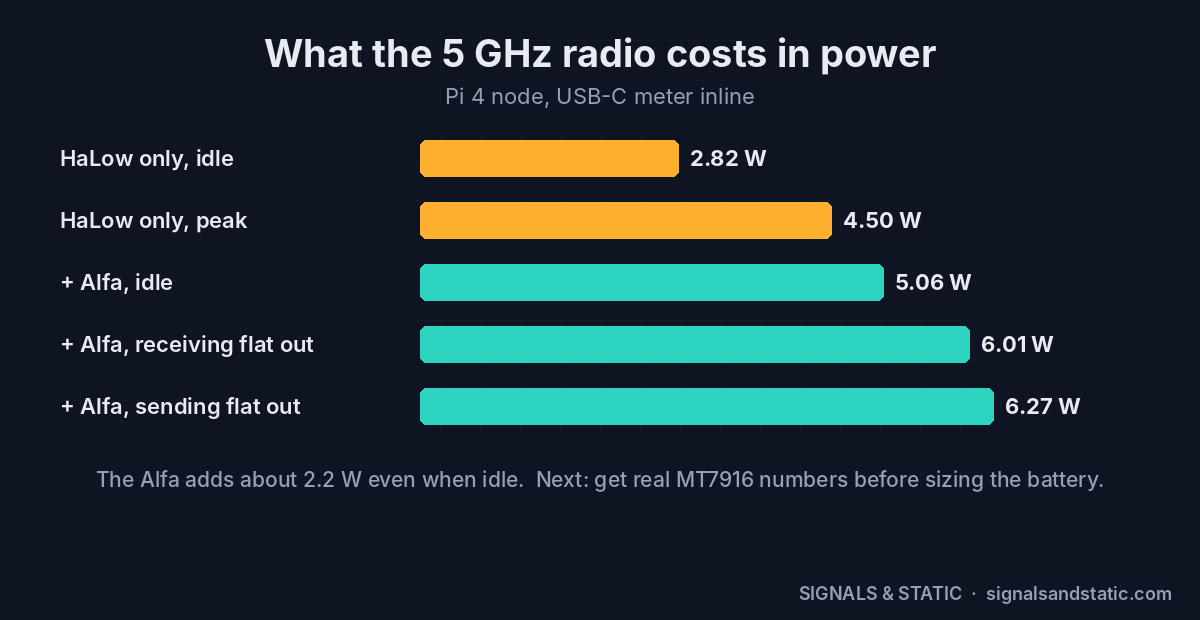
The 5 GHz adapter adds about 2.2 W even sitting idle.
With a USB-C meter inline on node 1: 5.06 W idle with both meshes up, 6.01 W receiving flat out, and 6.27 W sending flat out. Without the Alfa it was 2.82 W idle. That ~2.2 W idle cost matters for the handheld: on the battery I’ve been sketching, it could cut idle runtime from roughly 9 hours to 5 if the MT7916 draws like the Alfa. So I need real MT7916 numbers before the pack size is final. Shutting the 5 GHz radio down when no 5 GHz neighbors are around is on the idea list.
Remaining tests
- Prove the scripts: remove 5 GHz from node 2 with the removal script, then add it back from the gate with one command.
- Boot without the 5 GHz radio and mix with a stock node: the node with its radio removed acts as stock OpenMANET. The mesh and PTT need to keep working with no route flapping. The script test above covers this too.
- Upload and MTU check: track down the low upload through node 2.
- Voice bitrate: run PTT at higher Opus bitrates over 5 GHz vs HaLow. This is groundwork for the adaptive-voice idea.
- Outdoor walk test with GPS logging: carry node 2 away from the house while talking. It shows where 5 GHz hands off to HaLow and back, whether the audio hiccups during a soft failover, and finally gives me a HaLow range baseline.
- Save everything and reset: configs and logs off both nodes, nodes back to a known state.
Open issues to chase after that: the bulk-flow starvation (check whether voice packets carry DSCP EF so the Wi-Fi voice queue can help), tuning the 4–5 second failover gap (the originator interval is 1000 ms, and the ELP interval on mesh5g is a candidate), and MT7916 power figures.
Dropped: the USB 2 vs USB 3 comparison. Every future Pi unit will run its Alfa from a blue USB 3 port anyway, and moving the adapter means redoing the radio config for the new port.
The OpenMANET build log
—
TL;DR: A 5 GHz mesh link bonded into batman-adv next to HaLow (bonding off) took the bench nodes from 4.3 Mbps to 128–185 Mbps. Failover to HaLow costs 4–5 seconds, and transfers survive it. Pulling the USB radio from a running node can lock up the kernel, which the PCIe handheld won’t care about. Bulk traffic starves other users, but PTT stays clean because it rides both bands. Next up: script tests, stock interop, MTU, voice bitrate and an outdoor walk test.